
Brand & press
Vibely brand kit
Logo files, colour values, typography and boilerplate. Take what you need — no permission required for editorial use. If you need something that is not here, write to us and we will make it.
- Press enquiries
- hello@vibely.sh
- Support
- support@vibely.sh
- Logo files
- Download the mark (SVG)
- Careers
- Open roles at Vibely
Logo
Vibely has one mark. The same file is the app icon and the favicon — there is no separate icon artwork and no wordmark lockup, so set the name in plain text beside the mark if you need one.


Using the mark
Do
- Use the SVG. It is the master file and stays sharp at any size.
- Leave clear space around the mark on all four sides equal to the height of the centre dot — roughly a quarter of the mark. Nothing else goes inside that box.
- Use the reversed file on dark backgrounds rather than inverting the Terra Cotta one.
- Keep the mark at 24px or larger. Below that the radiating strokes close up and it reads as a blob.
Don’t
- Don’t recolour the mark. It is Terra Cotta on light and the off-white reversed file on dark, and nothing else.
- Don’t set the mark on a busy photo. Put it on a flat surface, or on a solid panel over the photo.
- Don’t stretch, rotate, outline, add a drop shadow, or rebuild the mark from scratch.
- Don’t set the word "Vibely" in a decorative face next to the mark, and don’t lock up the mark with another company’s logo without asking us.
Colour
A warm cream page, ink text in three strengths, a hairline for structure and one terra-cotta accent. Most of any page is cream and ink; the accent is used sparingly.
Cream
#faf9f5
The page canvas behind every marketing page, and the text colour on dark bands. Not pure white.
Ink
#141413
Headlines, primary text, the dark closing bands and the surface the reversed mark sits on. Not pure black.
Secondary
#5e5d59
Supporting copy: ledes, captions under a headline, labels next to a value.
Muted
#87867f
The quietest text: eyebrows, metadata, footnotes and placeholder copy.
Hairline
#e3e1d7
Borders, dividers and card outlines. One pixel, never a shadow-sm in its place.
Terra Cotta
#cc785c
The one accent. The mark is drawn in it, and it marks links and highlights sparingly.
One caveat for designers: the product UI uses a slightly warmer Terra Cotta, #d97757, for interactive accents. For anything published about Vibely, use #cc785c — that is the mark.
Typography
Three families, all free under the SIL Open Font License: a serif for display, a sans for reading and a mono for code.
Display and headings
Describe it. Watch it ship.
Newsreader. Every headline, from the hero down to card titles, in Newsreader Medium with no extra tracking. The largest hero lines use the Regular weight.
Body and interface
Vibely turns a prompt into a working app for the web and for native iOS and Android.
Inter. Paragraphs, buttons, navigation, forms and labels. Body copy runs at the Regular weight, 15 to 17px.
Code
src/routes/index.tsx
Geist Mono. Code, commands, file names, skill names and hex values like the ones above.
If you are rebuilding a Vibely headline and Newsreader is unavailable, a book-weight serif such as Georgia is closer to right than a grotesque.
Product screenshots
Use these rather than cropping our marketing site. They are current builds of the real product. Right-click to save at full resolution.
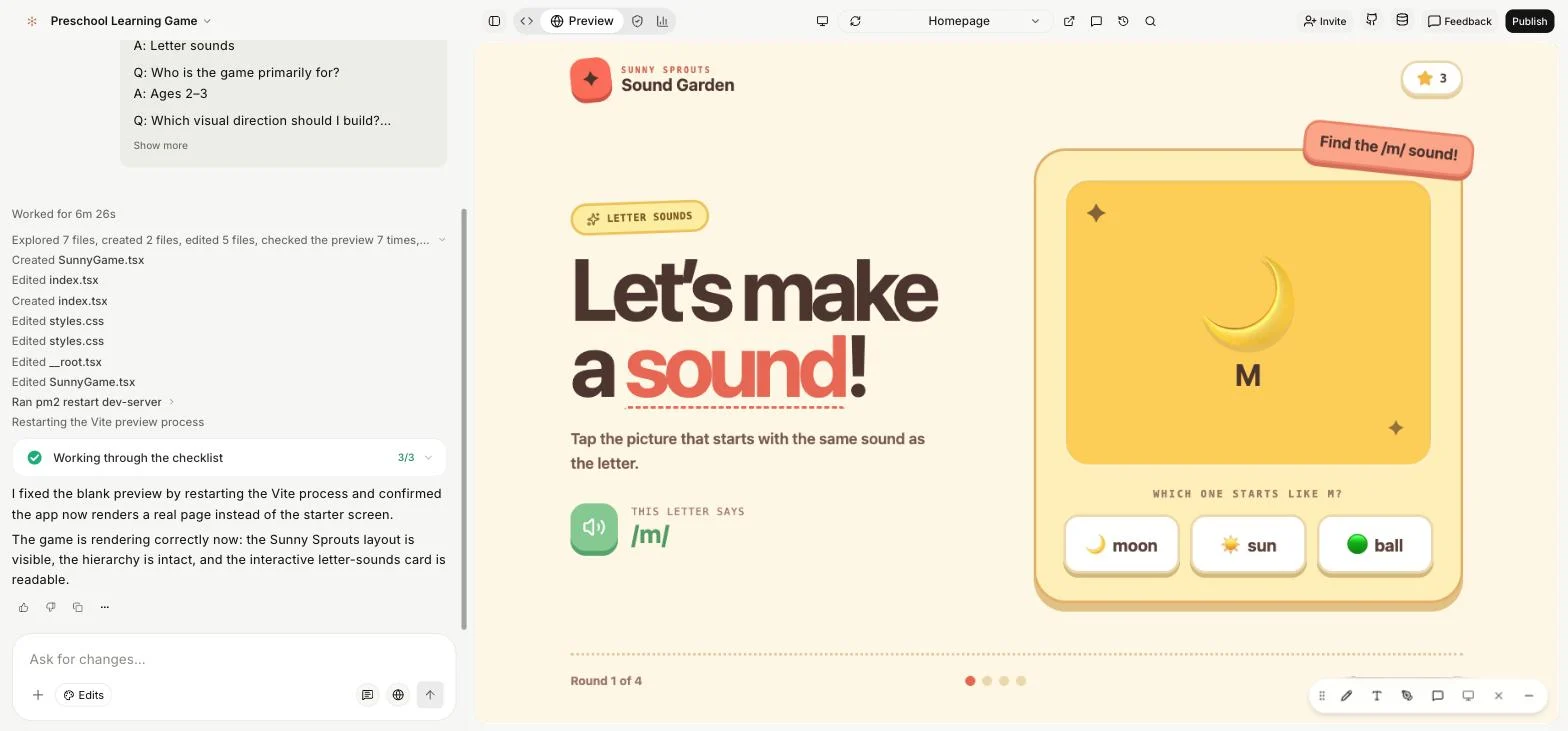
The builder — chat on the left, live preview on the right
WEBP · builder-web-app.webp. The same workspace builds native iOS and Android apps; switch the preview to Mobile and it renders an Expo Go QR code you scan to run the app on a real phone.
Boilerplate
One line
Vibely turns a prompt into a working app — for the web and for native iOS and Android.
Paragraph
Vibely is a prompt-to-app builder. You describe what you want and Vibely writes, runs and deploys it — as a web app, or as a real React Native app you open on your own phone through Expo Go while you are still building it. Generated apps can be wired to a database, authentication, payments and other services through Vibely’s built-in connectors, and shipped to a live URL from the same screen. Vibely is built and operated by Mana Intelligence Pvt Ltd, a company incorporated in India.
Facts for directory and list editors
If you list or compare Vibely, copy from here. Every figure on this page is rendered from the same source as our pricing page and /llms.txt, so it is current as of the moment you load it.
Name and description
Vibely AI app builder (vibely.sh)
Vibely turns a prompt into a working app — for the web and for native iOS and Android.
Please link to vibely.sh. If your listing has room for a longer identifying line, use this one: Vibely at vibely.sh is the AI app builder operated by Mana Intelligence Private Limited, a software company incorporated in India. It generates full-stack web and mobile applications from natural-language prompts, and the output is React and TypeScript source code the customer owns.
Company
- Operated by
- Mana Intelligence Private Limited
- Incorporated
- 21 January 2026, in India
- Based in
- Hyderabad, Telangana, India
Pricing
- Free — Free to start, web and mobile apps. No credit card needed.
- Lite — For one person building a little every month: monthly credits, custom domains, App Store and Google Play publishing, and the GitHub and Supabase integrations.
- Pro — Everything in Lite plus team roles and larger credit amounts, priced by the monthly credits chosen.
- Business — For teams: everything in Pro plus SSO, SCIM, private publishing and a shared credit pool.
- Enterprise — Set on a signed Order through sales.
App Store and Google Play publishing, custom domains, GitHub sync and the Supabase integration are on paid plans; native iOS and Android apps are on every plan. Current pricing: vibely.sh/pricing.
What Vibely does
- Prompt to a full-stack web app (Vite + React + TypeScript + Tailwind) in an isolated per-project cloud sandbox, with a live preview URL.
- Prompt to a native mobile app (Expo / React Native) with an Expo Go preview, on every plan. EAS cloud builds and TestFlight and Play internal-testing uploads: paid plans only.
- A Supabase Postgres database, authentication and row-level security; GitHub sync (branches, pull requests, linking an existing repo); publishing to a slug.vibelyagent.com subdomain; custom domains on paid plans.
- 115 connectors, all listed at https://vibely.sh/connectors: Vibely AI, GitHub, Supabase, Stripe, RevenueCat, Notion, Linear, Miro, Figma, Google Drive, Gmail, Google Calendar, Google Sheets, Google Docs, Google Slides, Google Search Console, and the rest from Slack, HubSpot and Shopify to Snowflake, AWS and ElevenLabs. Anything else is reached by registering your own MCP server URL or by asking the agent to write a REST integration with your key.
- Shared workspaces with Owner, Admin, Editor and Viewer roles, member groups, invites and comments on builds. SSO (SAML/OIDC), SCIM and audit logs on Business.
- Version history with checkpoints and restore, visual edits in the live preview, automated security scanning of the generated code, and monitoring that switches on at first publish and reports the errors your visitors hit.
- A Vibely MCP server at https://api.vibely.sh/mcp (OAuth sign-in, 52 tools, 7 scopes): build, edit, review and publish Vibely apps from Claude, ChatGPT, Cursor, Claude Code, VS Code or Codex. Only three of its tools use credits.
- Agent integrations: Vibely can add an MCP server at /mcp to a published web app, with one tool per action the app already does, so its users can reach it from ChatGPT, Claude or Cursor.
- Vibely AI: AI features inside your app (chat, summaries, search, images, video, voice) on a managed gateway with models from Google, OpenAI and Anthropic. No provider API key; usage is billed in workspace credits.
- Build, Plan and Chat agent modes; Add context, which lets the agent read another project in your workspace; and workspace and project Knowledge the agent follows on every message.
- Built-in visitor analytics for published web apps, with nothing to set up: visitors, pageviews, top pages, sources, devices, countries and campaigns. No cookies, no IP addresses stored, raw data deleted after 90 days.
- A basic security scan on every publish and a deep scan (dependencies, row-level security, database checks), both free on every plan, plus publish guardrails. The Security center covers every project in a workspace on Business.
What Vibely does not do
- No public or developer API. Every endpoint authenticates with the browser session token the app itself holds; there is no personal access token, OpenAPI spec or SDK. The only issued keys are a per-project AI-gateway key and MCP keys.
- No desktop app. Vibely runs in the browser.
- No partner, expert, agency or affiliate programme. There is a referral credit, and that is all.
- Not SOC 2 certified and not ISO 27001 certified. We hold neither report, and no audit or certification process against either framework is under way.
- No monorepo or subdirectory support: one app per repository.
- No design canvas and no drag-and-drop builder. You edit visually by clicking elements in the live preview, and you can import from Figma.
- No region selection or data residency guarantee.
- No real-time multiplayer editing and no live cursors. Presence is limited to up to four avatars of who else is viewing a project.
- No autonomous AI operator. Monitoring switches on when you first publish; a daily check reports the errors your visitors hit. It does not fix, deploy, answer users or change content by itself.
- The only uptime commitment we publish is 99.5% monthly for paid workspaces, in the SLA below. Any higher figure attributed to Vibely is wrong.
These lists are the same text as the scope section of /llms.txt. The SLA they refer to is at /sla.
Categories to list us under
- AI app builder
- Lovable alternative
- Rork alternative
- Bolt alternative
Press contact
Writing about Vibely?
Put “Press” in the subject line and we will get back to you. Ask us for a screenshot of something specific, a quote, or a fact check — we would rather answer than be guessed at.