
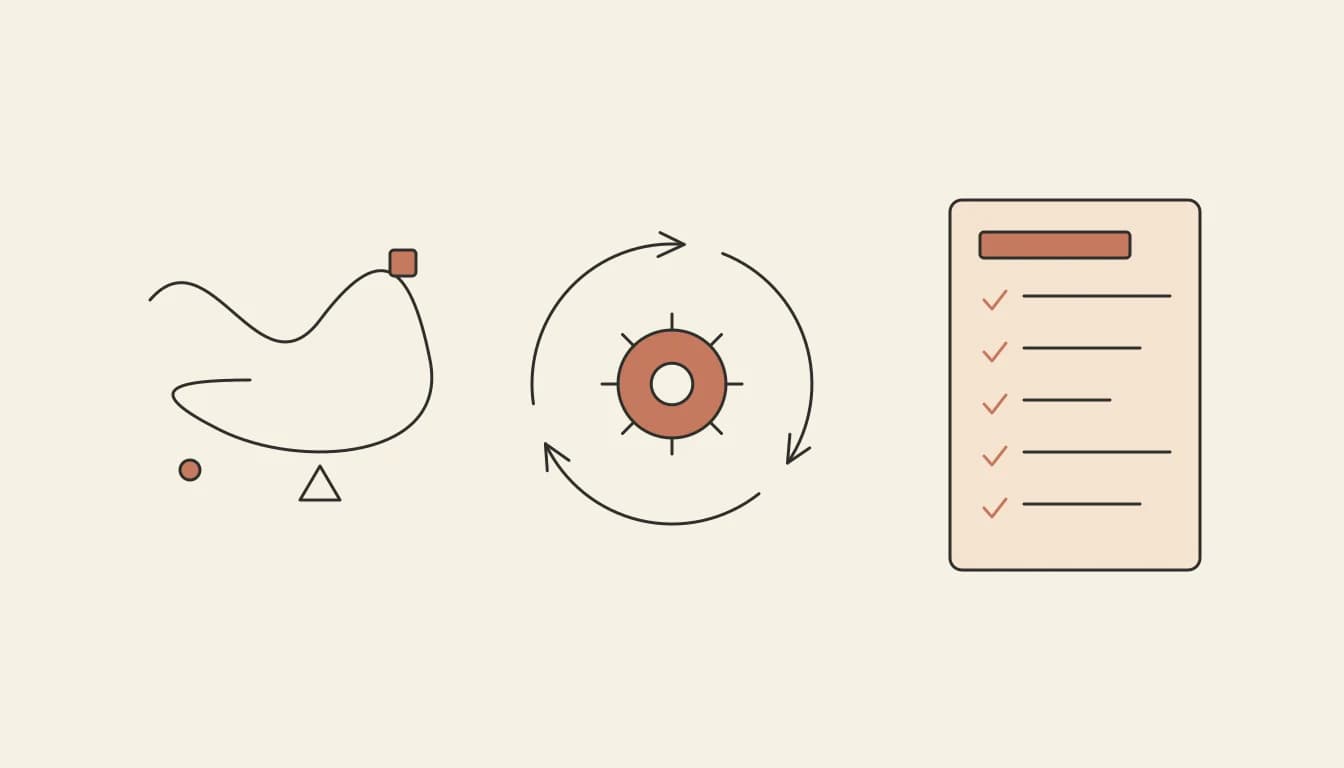
Vibe coding, agentic coding and spec-driven development are three ways to build software with AI. They differ in who decides and who checks the result. In vibe coding you steer by how the app behaves. In agentic coding an AI agent plans and runs the work. In spec-driven development a spec comes first, and the code is checked against it.
The short version
| Approach | You write | The AI does | You check by | Good for |
|---|---|---|---|---|
| Traditional coding | The code | Nothing, or autocomplete | Reading and testing it | Anything, slowly |
| AI-assisted coding | Most of the code | Suggestions and answers | Reading every suggestion | Developers in an editor |
| Vibe coding | Prompts | All of the code | Using the result | Prototypes and personal tools |
| Agentic coding | A goal | Plans, edits, runs and fixes, in a loop | Its checks, then yours | Multi-file work on a real codebase |
| Spec-driven development | A spec | A plan, tasks and code from the spec | Comparing the code to the spec | Apps that must keep working |
What is vibe coding?
Vibe coding is building software by describing it to an AI and accepting the code it writes without reading it line by line. Andrej Karpathy named it in February 2025: you talk to the model, accept its changes, paste errors back in and judge the result by running it. It is fast and fun, and it is how many people build their first app. The risk is that nobody has read the code, so problems you cannot see in the app, such as a database anyone can read, stay hidden. Our complete guide to vibe coding covers the method.
What is agentic coding?
Agentic coding hands an AI agent a goal rather than a single request. The agent plans the work, reads the files it needs, makes edits across them, runs commands such as the build or the tests, reads the errors and tries again until it is done. You review the outcome instead of each keystroke. The quality depends on the checks inside the loop: an agent that builds and tests its own changes catches mistakes a chat reply never sees. We wrote about why one well-checked loop beats a swarm of sub-agents.
What is spec-driven development?
Spec-driven development puts a written spec before any code: what the app does, for whom, and how you will know it works. The AI turns the spec into a plan, the plan into tasks and the tasks into code, and the spec stays the reference when something is unclear. GitHub's open-source Spec Kit sums it up as defining "what to build and why", then turning the specification into a plan, tasks and working code (Spec Kit on GitHub). It is slower to start and much easier to keep correct as the app grows.
Vibe coding vs agentic coding
The difference is the loop. In vibe coding you are the loop: you prompt, look, and prompt again. In agentic coding the agent runs its own loop of edit, build and test before it hands back. You can vibe code with an agent, and most people now do; the agent simply catches more on the way.
Vibe coding vs spec-driven development
Vibe coding decides as it goes, and spec-driven development decides first. If you are exploring an idea, deciding first is premature. If other people depend on the app, deciding as you go means the app's rules live only in old prompts, and the next change can quietly break them.
Vibe coding vs traditional coding and AI-assisted coding
In traditional coding you write and read every line. AI-assisted coding keeps you in charge of every line but speeds up writing them. Vibe coding gives the writing away entirely. That is why it opened software to people who do not code, and why it needs other checks to replace the reading.
What about vibe engineering?
People use "vibe engineering" for vibe coding done with an engineer's habits: tests, review, version control and a clear idea of what done means. In practice it sits close to agentic and spec-driven work.
Which one should you use?
- A prototype or a tool only you use: vibe code it. Speed matters more than structure.
- A change across a codebase you already have: use an agent, and let it build and test before you review.
- An app with users, payments or personal data: write the spec first, build with an agent, and keep the spec current.
How Vibely mixes the three
Vibely's agent is built around this mix. Plan mode writes a plan, close to a spec, that you edit and approve before any code changes. Build mode is the agent loop: every turn that changes files is type-checked and built before it finishes. And you can still steer by feel, by pointing at the preview and describing what should change. A security scan runs on every publish, so the checks that reading the code would give you are not skipped.
Frequently asked questions
Is vibe coding the same as agentic coding?
No. Vibe coding is about how you treat the code (you do not read it); agentic coding is about how the AI works (a multi-step loop with tools). You can do either without the other.
Is spec-driven development only for big teams?
No. A one-page spec helps a solo builder as much as a team, because it is what the AI checks its work against. Plan mode in Vibely gives you one without writing it from scratch.
Next step: try Plan mode in Vibely: describe an app, edit the plan it writes, then let it build.